Object-Oriented Programming (OOP) in PHP: A Complete Beginner's Guide
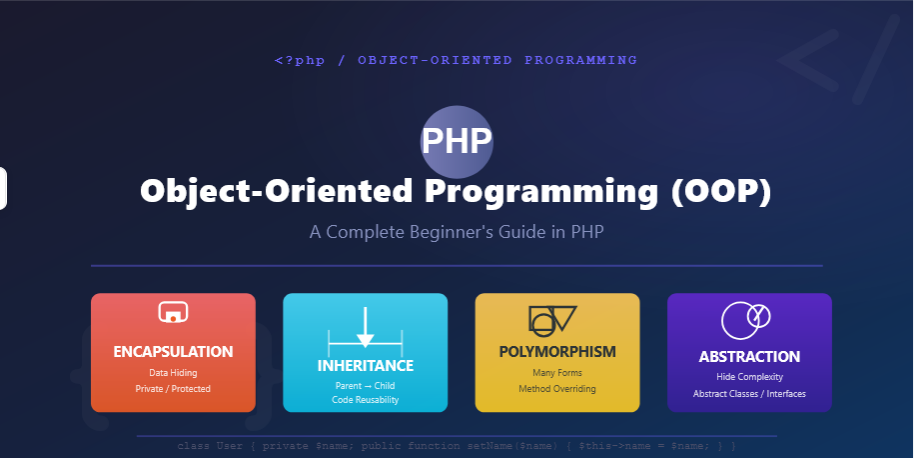
Object-Oriented Programming (OOP) in PHP: A Complete Beginner's Guide
As your PHP applications grow, writing all your code in a single file quickly becomes difficult to manage. This is where Object-Oriented Programming (OOP) becomes valuable.
OOP is a programming approach that organizes code into reusable objects and classes. It makes applications easier to maintain, expand, and test. Most modern PHP frameworks, including Laravel and Symfony, rely heavily on OOP principles.
In this guide, you'll learn the core concepts of Object-Oriented Programming in PHP with beginner-friendly explanations and practical examples.
What Is Object-Oriented Programming?
Object-Oriented Programming (OOP) is a programming paradigm that models software using objects.
An object combines:
Data (properties)
Behavior (methods)
For example, consider a Car.
Properties: Brand, Color, Model, Speed
Methods:
Start()
Stop()
Accelerate()
Brake()
Instead of writing unrelated functions, OOP groups related data and behavior together.
Why Learn OOP?
Learning OOP offers many advantages:
Better code organization
Reusable code
Easier maintenance
Improved scalability
Cleaner application structure
Easier collaboration with other developers
Most professional PHP applications use OOP because it simplifies large projects.
Understanding Classes
A class is a blueprint used to create objects.
Example:
<?php
class Car{
public $brand;
public $color;
}
?>
The class defines what every Car object should contain.
Creating Objects
An object is created from a class.
<?php
$car = new Car();
$car->brand = "Toyota";
$car->color = "Blue";
?>
Now $car represents a real object based on the Car class.
Accessing Properties
Display object information:
<?php
echo $car->brand;
echo "<br>";
echo $car->color;
?>
Output:
Toyota
Blue
Methods
Methods are functions inside a class.
Example:
<?php
class Car{
public function start(){
echo "Engine Started";
}
}
$car = new Car();
$car->start();
?>
Methods define what an object can do.
Constructors
A constructor runs automatically when an object is created.
<?php
class Student{
public $name;
function __construct($name){
$this->name = $name;
}
}
$student = new Student("John");
echo $student->name;
?>
Constructors are useful for initializing object properties.
The $this Keyword
Inside a class, $this refers to the current object.
Example:
<?php
class User{
public $name;
function setName($name){
$this->name = $name;
}
}
?>
$this allows methods to access the object's own properties and methods.
Access Modifiers
PHP provides three visibility levels.
Public
Accessible from anywhere.
public $name;
Private
Accessible only inside the class.
private $password;
Protected
Accessible inside the class and by child classes.
protected $salary;
Using appropriate visibility improves security and code organization.
Encapsulation
Encapsulation means hiding internal data and exposing only what is necessary.
Example:
<?php
class Account{
private $balance = 0;
public function deposit($amount){
$this->balance += $amount;
}
public function getBalance(){
return $this->balance;
}
}
?>
Users cannot modify $balance directly, helping protect the object's state.
Inheritance
Inheritance allows one class to reuse another class.
<?php
class Animal{
public function speak(){
echo "Animal Sound";
}
}
class Dog extends Animal{
}
$dog = new Dog();
$dog->speak();
?>
The Dog class automatically inherits the speak() method from Animal.
Polymorphism
Polymorphism allows different classes to provide different implementations of the same method.
Example:
<?php
class Animal{
public function sound(){
echo "Animal Sound";
}
}
class Cat extends Animal{
public function sound(){
echo "Meow";
}
}
class Dog extends Animal{
public function sound(){
echo "Bark";
}
}
?>
Each class responds differently to the same method call.
Abstraction
Abstraction hides implementation details while exposing essential functionality.
Example:
<?php
abstract class Vehicle{
abstract public function move();
}
class Car extends Vehicle{
public function move(){
echo "Car Moving";
}
}
?>
Abstract classes define required behavior without providing complete implementations.
Interfaces
Interfaces define methods that classes must implement.
Example:
<?php
interface Payment{
public function pay();
}
class PayPal implements Payment{
public function pay(){
echo "Payment Successful";
}
}
?>
Interfaces make applications more flexible and easier to extend.
Static Methods
Static methods belong to the class instead of individual objects.
Example:
<?php
class MathHelper{
public static function square($number){
return $number * $number;
}
}
echo MathHelper::square(5);
?>
Output: 25
Static methods are useful for utility functions that don't depend on object data.
Namespaces
Namespaces help organize code and avoid class name conflicts.
Example:
<?php
namespace App\Models;
class User{
}
?>
Large projects commonly use namespaces to group related classes.
Autoloading
Instead of manually including every class file, modern PHP projects use autoloading.
Composer automatically loads classes when they are needed, making applications cleaner and easier to maintain.
OOP Best Practices
Professional developers typically:
Give classes a single responsibility.
Use meaningful class names.
Keep methods short and focused.
Hide internal data with encapsulation.
Prefer composition when appropriate.
Organize code with namespaces.
Follow consistent coding standards.
Common Beginner Mistakes
Avoid these common errors:
Creating very large classes.
Making every property public.
Repeating code instead of using inheritance.
Ignoring constructors.
Misusing static methods.
Forgetting to initialize object properties.
Practical Mini Project
Build a Library Management System using OOP.
Suggested classes:
Book
Member
Librarian
Loan
Category
Implement:
Add books
Register members
Borrow books
Return books
Display available books
This project helps you practice classes, objects, inheritance, encapsulation, and methods in a realistic application.
Helpful Tools
Useful tools for PHP OOP development include:
Visual Studio Code
Composer
XAMPP
Laragon
Git
GitHub
PHPStan
PHPUnit
These tools improve productivity, code quality, and testing.
Frequently Asked Questions
Is OOP difficult for beginners?
Not necessarily. It introduces new concepts, but with practice, OOP becomes a natural way to organize code.
Do I need OOP to learn PHP?
No. You can start with procedural PHP, but learning OOP is essential if you want to build larger applications or work with modern PHP frameworks.
What are the four pillars of OOP?
The four fundamental principles are:
Encapsulation
Inheritance
Polymorphism
Abstraction
Understanding these concepts provides a strong foundation for professional PHP development.
Conclusion
Object-Oriented Programming is one of the most valuable skills for PHP developers. By learning how to create classes and objects, use inheritance, protect data with encapsulation, implement polymorphism, and organize code effectively, you'll be able to build cleaner, more maintainable applications.
As you continue learning, explore advanced topics such as traits, dependency injection, design patterns, unit testing, and modern PHP frameworks like Laravel. Mastering OOP will prepare you for building scalable, production-ready web applications.
For More Reading
1. The Official Source (The PHP Manual)
The absolute authority. While a bit technical, the official manual has excellent examples and is the ultimate reference for syntax.
- PHP Manual – Classes & Objects (Overview)
🔗 https://www.php.net/manual/en/language.oop5.php
(Start here to see the big picture of what OOP in PHP looks like). - PHP Manual – The Basics (Properties & Methods)
🔗 https://www.php.net/manual/en/language.oop5.basic.php
(Deep dive into class syntax, new keyword, $this, and defining properties). - PHP Manual – Constructors & Destructors
🔗 https://www.php.net/manual/en/language.oop5.decon.php
(Essential for understanding how objects are initialized and cleaned up). - PHP Manual – Visibility (Public, Private, Protected)
🔗 https://www.php.net/manual/en/language.oop5.visibility.php
(The cornerstone of encapsulation—absolute must-read).
2. Step-by-Step Beginner Tutorials (Structured Courses)
If the manual feels too dense, start with these beginner-friendly walkthroughs.
- W3Schools – PHP OOP Tutorial
🔗 https://www.w3schools.com/php/php_oop_what_is.asp
(Extremely beginner-friendly, bite-sized chapters with "Try it Yourself" examples). - GeeksforGeeks – Object-Oriented Programming in PHP
🔗 https://www.geeksforgeeks.org/php-object-oriented-programming/
(Covers the theory behind OOP (Abstraction, Encapsulation, etc.) alongside PHP code snippets). - TutorialsPoint – PHP OOP Concepts
🔗 https://www.tutorialspoint.com/php/php_object_oriented.htm
(A classic, no-frills walkthrough perfect for quick reference).
3. Practical, Project-Based Guides (Learn by Doing)
These guides take you beyond syntax and show you how to build real mini-projects (e.g., a User system or Shopping Cart).
- Kinsta – Object-Oriented Programming in PHP: A Beginner’s Guide
🔗 https://kinsta.com/blog/php-object-oriented-programming/
(Written by hosting experts, this guide explains why OOP matters for real-world web apps). - CodeShack – PHP OOP Tutorial for Beginners
🔗 https://codeshack.io/object-oriented-programming-php-beginners-guide/
(Very visual and practical—they build a simple CRUD (Create, Read, Update, Delete) system using OOP). - SitePoint – Object-Oriented PHP for Beginners
🔗 https://www.sitepoint.com/object-oriented-php-for-beginners/
(SitePoint has a legendary series on PHP—search their blog for "OOP" for dozens of practical articles). - Zend Blog – OOP Basics in PHP
🔗 https://www.zend.com/blog/object-oriented-programming-php-beginners
(A straight-to-the-point guide from the creators of the PHP engine).
4. Video Series & Interactive Learning
Some beginners grasp OOP much faster visually. These are the gold-standard video series.
- Laracasts – PHP for Beginners (2025 Edition)
🔗 https://laracasts.com/series/php-for-beginners-2023-edition
(Jeffrey Way teaches OOP by building a real project from scratch. Some content is free; the entire series is well worth the subscription). - Traversy Media (YouTube) – PHP OOP Tutorial
🔗 https://www.youtube.com/watch?v=Anz0ArcQ5kI
(A 1-hour crash course that covers Classes, Constructors, Getters/Setters, and Inheritance in a clear, calm manner). - Program with Gio (YouTube) – PHP OOP Full Course
🔗 https://www.youtube.com/watch?v=G0h2tWXMHtM
(A more detailed, slow-paced course perfect for absolute beginners who want to code along).
5. Deep Dives into Specific OOP Concepts
Once you have the basics, read these to really understand the "why" behind each pillar of OOP.
- Encapsulation & Getters/Setters Explained
🔗 https://www.php.net/manual/en/language.oop5.visibility.php (Official)
🔗 https://www.geeksforgeeks.org/encapsulation-in-php/ (Beginner breakdown) - Inheritance (Extends) – Official Deep Dive
🔗 https://www.php.net/manual/en/language.oop5.inheritance.php
(Understand parent/child classes and the parent:: keyword). - Polymorphism & Abstract Classes
🔗 https://www.php.net/manual/en/language.oop5.abstract.php
(Crucial for when you want to define "blueprints" that child classes must follow). - Interfaces (Contracts)
🔗 https://www.php.net/manual/en/language.oop5.interfaces.php
(The secret to writing flexible, testable code—crucial for beginners to learn early). - Traits (Code Reuse)
🔗 https://www.php.net/manual/en/language.oop5.traits.php
(PHP's solution to multiple inheritance—great to know, but skip this until you're comfortable with classes). - Static Properties & Methods
🔗 https://www.php.net/manual/en/language.oop5.static.php
(When to use static vs. when to create an object).
6. From Beginner to Intermediate (Connecting OOP to Frameworks)
OOP really shines when you see it used in popular frameworks. Reading framework docs helps bridge the gap.
- Laravel Documentation – Core Concepts (Eloquent, Services)
🔗 https://laravel.com/docs/11.x/eloquent (See how Active Record OOP works)
🔗 https://laravel.com/docs/11.x/container (See Dependency Injection in action) - Symfony Documentation – The Service Container
🔗 https://symfony.com/doc/current/service_container.html
(A great example of how professional OOP code is organized).